Climate region · Pacific Northwest
Pacific Northwest landscaping for wet winters and dry summers.
Combine sword ferns, Oregon grape, red-flowering currant and Pacific dogwood into lush four-season gardens that shrug off January rain and August drought.
- Zone 8b
- Portland, OR (97214) (15 to 20 °F)
- 35–60 in / yr, mostly Oct–May
- typical annual rainfall
- 20 native
- 18 adapted in catalog
- Imperial · USD
- Northern Hemisphere
Plan a Pacific Northwest garden
Pre-configured for Portland, OR (97214) in imperial (sq ft) units and USD, with Northern Hemisphere seasons. Enter your own city, ZIP or postcode below to customize for your exact address.
1 · Pick a yard
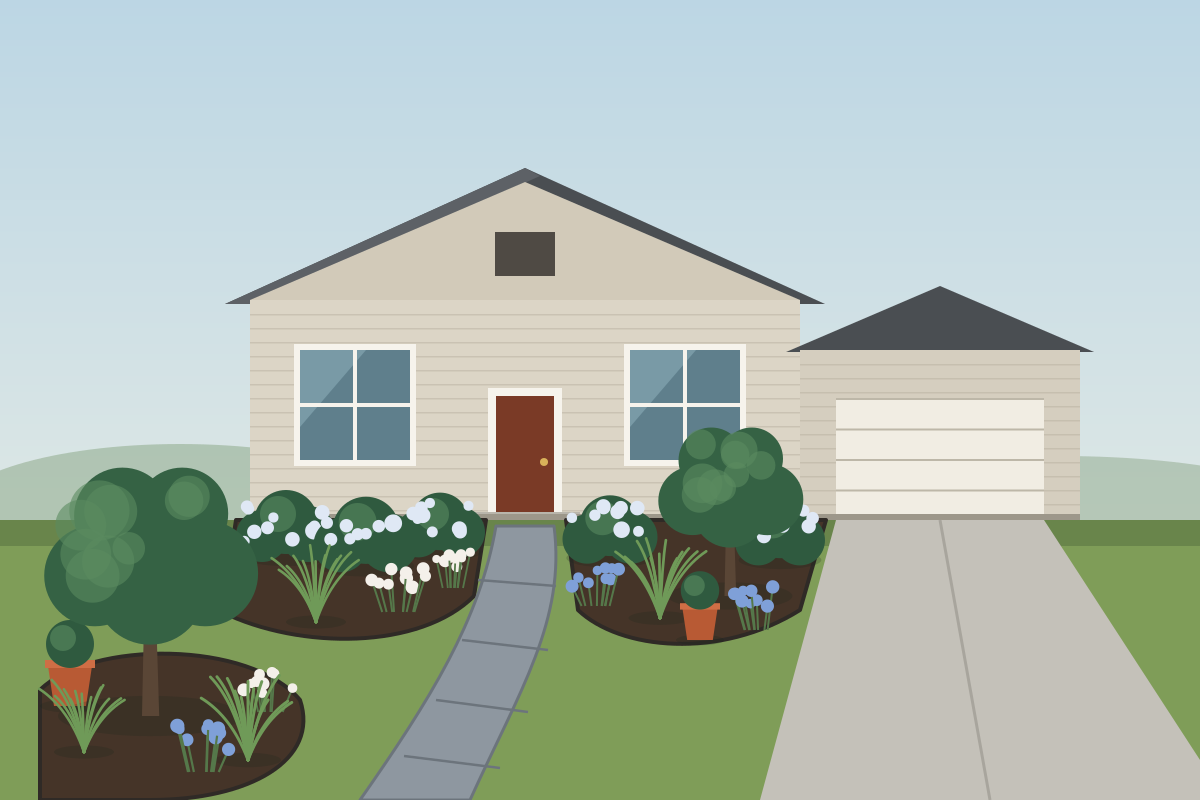
 OriginalCraftsman Foundation concept
Checking today's free renders…
2 · Tune the design
Units
USDA Zone 8b · Pacific NorthwestZIP 97214, OR, USA · winter low 15 to 20 °F
Area
Design style
Structured evergreen layers that frame the house.
Sun exposure
Landscape plan & nursery list
Craftsman Foundation Front Yard Plan
USDA Zone 8b · Pacific Northwest · ZIP 97214, OR, USA · 800 sq ft · Part Shade
- Plants
- 103
- Planting beds
- 240 sq ft
- DIY total
- $2,164
- Landscaper
- $5,260
Trees
$130
Vine Maple
Acer circinatum
- Zone
- 5–9
- Size
- 15 × 15 ft
- Bloom
- Scarlet fall color
- Water
- Moderate water
Native to your regionPet-safe1 × 15 gal
$130 each
$130
Shrubs
$264
Tall Oregon Grape
Mahonia aquifolium
- Zone
- 5–9
- Size
- 5 × 4 ft
- Bloom
- Yellow, March–April
- Water
- Low water
Native to your regionPet-safeDrought-tolerantDeer-resistant4 × 3 gal
$36 each
$144
Evergreen Huckleberry
Vaccinium ovatum
- Zone
- 7–9
- Size
- 5 × 5 ft
- Bloom
- Pink bells, April–May
- Water
- Moderate water
Native to your regionPet-safe3 × 3 gal
$40 each
$120
Perennials
$216
Western Sword Fern
Polystichum munitum
- Zone
- 5–9
- Size
- 3 × 3 ft
- Bloom
- Evergreen fronds
- Water
- Moderate water
Native to your regionPet-safeDrought-tolerantDeer-resistant3 × 1 gal
$16 each
$48
Pacific Bleeding Heart
Dicentra formosa
- Zone
- 4–8
- Size
- 1.5 × 2 ft
- Bloom
- Pink, April–June
- Water
- Moderate water
Native to your regionToxic to petsDeer-resistant6 × 1 gal
$14 each
$84
Chinese Astilbe
Astilbe chinensis
- Zone
- 4–8
- Size
- 2 × 2 ft
- Bloom
- Pink plumes, June–July
- Water
- Regular water
Regionally adaptedPet-safeDeer-resistant6 × 1 gal
$14 each
$84
Ornamental grasses
$98
California Fescue
Festuca californica
- Zone
- 7–10
- Size
- 2 × 2 ft
- Bloom
- Blue-green blades
- Water
- Low water
Native to your regionPet-safeDrought-tolerantDeer-resistant7 × 1 gal
$14 each
$98
Groundcovers
$438
Dwarf Mondo Grass
Ophiopogon japonicus 'Nana'
- Zone
- 7–10
- Size
- 3 in × 8 in
- Bloom
- Evergreen tufts
- Water
- Moderate water
Regionally adaptedPet cautionDeer-resistant73 × quart
$6 each
$438
DIY vs. landscaper
| Item | DIY | Pro |
|---|---|---|
| Plants103 plants across 8 species | $1,146 | $1,490 |
| Soil & compost1.5 cu yd at 2 in deep | $63 | $117 |
| Mulch2.2 cu yd shredded hardwood mulch | $84 | $187 |
| Edging71 linear ft steel edging | $231 | $533 |
| Pavers & hardscape64 sq ft bluestone or brick walk | $480 | $1,344 |
| LaborDIY: about 33 hours of your time | $0 | $1,025 |
| Delivery & tool rentalBulk delivery plus plate compactor | $160 | $0 |
| Design & overhead12% contractor overhead | $0 | $564 |
| Total | $2,164 | $5,260 |
Doing it yourself saves about $3,096 for roughly 33 hours of work.
Planting notes
- Best planting window for Zone 8b: october through march (fall planting is best). Typical last spring frost Mar 7 – Mar 28; first fall frost Nov 7 – Nov 28.
- Pacific Northwest: Mild, wet winters and dry summers under tall conifers. Expect 35–60 in / yr, mostly Oct–May.
- Work 2 in of compost into the top 6 in of soil, then mulch 3 in deep, keeping it off stems and trunks.
- Water deeply twice a week for the first 8 weeks, weekly through the first summer, then taper. Established natives need supplemental water only in drought.
Year-round interest calendar
Northern Hemisphere · 8 species · 103 plants
Lawn-replacement water & cost savings
vs. irrigated turfgrass
- Water saved / yr
- 5,151 gal
- Water bill saved / yr
- $39
- Share of turf irrigation cut
- 25%
(19,499 L)
at local average water rates
Planning estimate — confirm with your utility.
Curious how another style compares? See a side-by-side water & cost readout.
Zone estimated from your ZIP, postal code or city using the 2023 USDA map and equivalents. Plants marked pet-safe are not listed as toxic by the ASPCA and are recognized as non-toxic to dogs and cats; “pet caution” means unlisted or mildly irritating. Prices shown in USD are converted from mid-range US estimates — confirm stock and pricing with your nursery. Water-savings figures are climate-adjusted planning estimates benchmarked against a thirsty cool-season lawn; confirm current rates with your utility.
Northern Hemisphere planting & bloom calendar
Seasonal timing for Pacific Northwest
Major metros in this region include Seattle, Portland, Vancouver BC, Tacoma, Eugene and Bellingham. Fall planting (September–November) is ideal—mild winter soil lets roots expand for six months before summer dry spells begin. Lean on native evergreen foliage for gray winter months.
- Best planting window
- October through March (fall planting is best)
- Typical last spring frost
- Mar 7 – Mar 28
- Typical first fall frost
- Nov 7 – Nov 28
- Growing season
- about 240–260 days
Regional 12-month bloom & evergreen calendar (Northern Hemisphere)
Across 38 native & adapted catalog species
Regional plant catalog
Native & adapted plants for Pacific Northwest
All 38 regional picks (20 native, 18 adapted) from YardCraft's 186-plant catalog, with Northern Hemisphere peak bloom windows.
Trees (4)
Autumn Brilliance Serviceberry
NativeAmelanchier × grandiflora
Zone 4–9 · 20 × 15 ft · Moderate water
Peak Apr
Vine Maple
NativeAcer circinatum
Zone 5–9 · 15 × 15 ft · Moderate water
Peak Sep–Nov · Pet-safe
Strawberry Tree
AdaptedArbutus unedo
Zone 8–10 · 20 × 15 ft · Low water
Sep–Nov · Evergreen · Drought-tolerant
Japanese Maple
AdaptedAcer palmatum
Zone 5–9 · 15 × 15 ft · Moderate water
Peak Apr–Oct · Pet-safe
Shrubs (10)
Concha California Lilac
NativeCeanothus 'Concha'
Zone 7–10 · 6 × 8 ft · Low water
Peak Mar–May · Drought-tolerant
Howard McMinn Manzanita
NativeArctostaphylos 'Howard McMinn'
Zone 7–10 · 6 × 7 ft · Low water
Peak Feb–Apr · Drought-tolerant
Red-Flowering Currant
NativeRibes sanguineum
Zone 6–9 · 8 × 6 ft · Low water
Peak Mar–Apr · Drought-tolerant
Tall Oregon Grape
NativeMahonia aquifolium
Zone 5–9 · 5 × 4 ft · Low water
Peak Mar–Apr · Drought-tolerant · Pet-safe
Evergreen Huckleberry
NativeVaccinium ovatum
Zone 7–9 · 5 × 5 ft · Moderate water
Peak Apr–May · Pet-safe
Red Twig Dogwood
NativeCornus sericea
Zone 2–8 · 7 × 8 ft · Moderate water
Peak May–Jun · Pet-safe
Dwarf Mugo Pine
AdaptedPinus mugo 'Pumilio'
Zone 2–7 · 4 × 6 ft · Low water
Evergreen year-round · Drought-tolerant
Glossy Abelia
AdaptedAbelia × grandiflora
Zone 6–10 · 5 × 5 ft · Low water
Peak May–Oct · Drought-tolerant · Pet-safe
Green Velvet Boxwood
AdaptedBuxus 'Green Velvet'
Zone 5–9 · 3 × 3 ft · Moderate water
Evergreen year-round
Sasanqua Camellia
AdaptedCamellia sasanqua
Zone 7–9 · 8 × 6 ft · Moderate water
Peak Oct–Dec · Pet-safe
Perennials (11)
Douglas Iris
NativeIris douglasiana
Zone 7–10 · 1.5 × 2 ft · Low water
Peak Mar–May · Drought-tolerant
Oregon Sunshine
NativeEriophyllum lanatum
Zone 5–9 · 1.5 × 2 ft · Low water
Peak May–Aug · Drought-tolerant
Seaside Daisy
NativeErigeron glaucus
Zone 8–10 · 1 × 2 ft · Low water
Peak Apr–Aug · Drought-tolerant
Sulphur Buckwheat
NativeEriogonum umbellatum
Zone 4–8 · 1 × 2 ft · Low water
Peak Jun–Aug · Drought-tolerant
Western Sword Fern
NativePolystichum munitum
Zone 5–9 · 3 × 3 ft · Moderate water
Evergreen year-round · Drought-tolerant · Pet-safe
Western Yarrow
NativeAchillea millefolium
Zone 2–9 · 2 × 2 ft · Low water
Peak May–Sep · Drought-tolerant
Pacific Bleeding Heart
NativeDicentra formosa
Zone 4–8 · 1.5 × 2 ft · Moderate water
Peak Apr–Jun
Hidcote English Lavender
AdaptedLavandula angustifolia 'Hidcote'
Zone 5–9 · 2 × 2 ft · Low water
Peak Jun–Aug · Drought-tolerant
Walker's Low Catmint
AdaptedNepeta × faassenii 'Walker's Low'
Zone 4–8 · 2 × 3 ft · Low water
Peak May–Sep · Drought-tolerant
Chinese Astilbe
AdaptedAstilbe chinensis
Zone 4–8 · 2 × 2 ft · Regular water
Peak Jun–Jul · Pet-safe
Halcyon Hosta
AdaptedHosta 'Halcyon'
Zone 3–9 · 1.5 × 3 ft · Moderate water
Peak Jul
Ornamental grasses (5)
California Fescue
NativeFestuca californica
Zone 7–10 · 2 × 2 ft · Low water
Evergreen year-round · Drought-tolerant · Pet-safe
Tufted Hairgrass
NativeDeschampsia cespitosa
Zone 2–9 · 3 × 2 ft · Moderate water
Peak Jun · Pet-safe
Elijah Blue Fescue
AdaptedFestuca glauca 'Elijah Blue'
Zone 4–8 · 1 × 1 ft · Low water
Evergreen year-round · Drought-tolerant · Pet-safe
Golden Japanese Forest Grass
AdaptedHakonechloa macra 'Aureola'
Zone 5–9 · 1.5 × 2 ft · Moderate water
Peak Apr–Oct · Pet-safe
Karl Foerster Feather Reed Grass
AdaptedCalamagrostis × acutiflora 'Karl Foerster'
Zone 4–9 · 5 × 2 ft · Moderate water
Peak Jun · Pet-safe
Groundcovers (8)
Kinnikinnick
NativeArctostaphylos uva-ursi
Zone 2–7 · 6 in × 4 ft · Low water
Peak Apr–May · Drought-tolerant
Redwood Sorrel
NativeOxalis oregana
Zone 7–9 · 6 in × 2 ft · Moderate water
Peak Apr–Jun
Wild Strawberry
NativeFragaria virginiana
Zone 2–9 · 5 in × 2 ft · Moderate water
Peak Apr–Jun · Pet-safe
Angelina Stonecrop
AdaptedSedum rupestre 'Angelina'
Zone 4–9 · 5 in × 2 ft · Low water
Evergreen year-round · Drought-tolerant · Pet-safe
Creeping Thyme
AdaptedThymus serpyllum
Zone 4–9 · 3 in × 1.5 ft · Low water
Peak Jun–Jul · Drought-tolerant · Pet-safe
Black Mondo Grass
AdaptedOphiopogon planiscapus 'Nigrescens'
Zone 6–10 · 6 in × 1 ft · Moderate water
Evergreen year-round
Dwarf Mondo Grass
AdaptedOphiopogon japonicus 'Nana'
Zone 7–10 · 3 in × 8 in · Moderate water
Evergreen year-round
Irish Moss
AdaptedSagina subulata
Zone 4–8 · 1 in × 1 ft · Regular water
Peak May · Pet-safe
Soil, climate & style match
Designing for Pacific Northwest
Acidic woodland soils, mild overcast winters with steady rainfall, and surprisingly rainless July–August summers under tall Douglas fir and cedar canopies.
Best landscape styles for this region
Regional playbook
Local planting & care checklist
- 01Anchor beds with 40%+ broadleaved evergreens and native ferns so gardens stay rich through gray winters.
- 02Mulch with coarse arborist wood chips to mimic conifer forest duff and hold moisture through dry August weeks.
- 03Avoid summer irrigation near mature native conifers and madrones.
- 04Keep shade beds under mature firs planted with compact starts so you disturb fewer feeder roots.
Questions
Pacific Northwest landscaping FAQ
What native plants grow best in Pacific Northwest?
Top regional picks in YardCraft's catalog for Pacific Northwest include California Fescue, Concha California Lilac, Douglas Iris, Howard McMinn Manzanita. In total, the catalog tracks 20 native and 18 adapted species for this region—enter your exact city or postal code in the studio to filter by sun exposure, drought tolerance and pet safety.
When is the best time to plant in Pacific Northwest?
For a representative Pacific Northwest location like Portland, OR (97214) (Zone 8b, Northern Hemisphere), the best planting window is october through march (fall planting is best). Fall planting (September–November) is ideal—mild winter soil lets roots expand for six months before summer dry spells begin. Lean on native evergreen foliage for gray winter months.
What rainfall and winter temperatures should I plan for in Pacific Northwest?
Pacific Northwest receives roughly 35–60 in / yr, mostly Oct–May. Around Portland, OR (97214), average annual minimum temperatures fall in the 15 to 20 °F band. Mild, wet winters and dry summers under tall conifers.
When is peak bloom season in Pacific Northwest?
Adjusted for the Northern Hemisphere calendar, the heaviest flowering months across YardCraft's Pacific Northwest plant palette fall around April, May, June, supported by evergreen shrubs and grasses that hold structure through the rest of the year.